Another in a series exploring ideas and observations about AI.
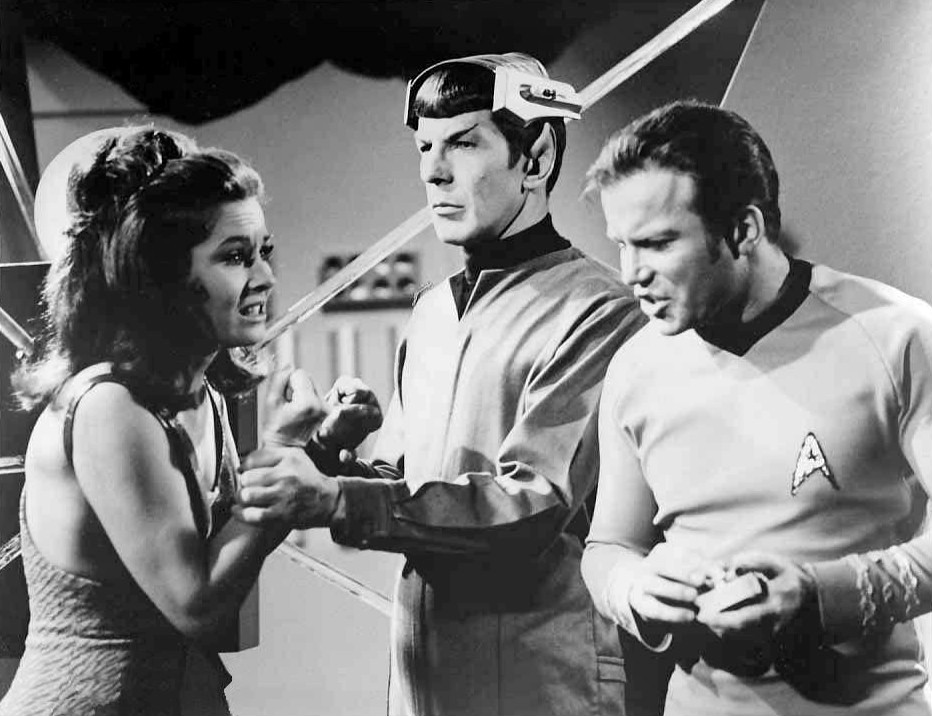
Beginning in 1966, Star Trek: The Original Series (TOS) boldly introduced mass TV audiences to the idea of “thinking computers,” aka artificial intelligence (AI).
While earlier programs such as The Twilight Zone explored this topic, Star Trek fused these themes with hope, exploration, and adventure. Captain Kirk and the Enterprise crew inspired generations of science fiction storytelling. Later TV series like Battlestar Galactica and Westworld, and also films such as War Games, The Terminator, even The Matrix owe a debt to Star Trek’s imaginative portrayals of AI.
Explore strange new worlds, new life and new civilizations (where AI runs amok) in some of the incidents from their five-year mission…
Mission Logs:
1. “What Are Little Girls Made Of?” (S1, E7)
The Enterprise arrives at planet Exo-III to find Dr. Roger Korby living with a few ancient androids left by a long-perished society. He creates new androids with humanlike intelligence to achieve immortality, blurring the line between human and machine.
Fun fact: the sentient androids killed their creators because they didn’t want to be slaves anymore. Korby makes a replica of Kirk, which attempts to take over the Enterprise and escape the planet, but Spock realizes the fake-out when it insults him.
Kirk exposes the androids’ limitations and Korby’s moral failures. Turns out Korby is also an android. Duh. Korby realizes he is no longer truly human and sacrifices himself.
2. “The Return of the Archons” (S1, E21)
Investigating the 100-year-old disappearance to the starship Archon, the Enterprise crew visits planet Beta III, to find it controlled by “Landru,” a computer that enforces societal harmony by suppressing individuality and free will. Landru was designed to maintain peace and order on a planet plagued by conflict.
The computer AI’s strict interpretation of “peace” led to the suppression of individuality and free will, creating a stagnant, lifeless society. Except for a lawless Purge-like “Festival” where the people go nuts.
Kirk and Spock confront Landru, forcing it into a logic paradox that reveals its failure to serve the people, leading to its shutdown.
3. “A Taste of Armageddon” (S1, E23)
Two warring planets use computers to simulate battles, requiring real citizens to report for execution to fulfill the simulated casualties. The war computers were designed to prevent total annihilation of both populations by using AI to simulate battles and enforce controlled casualties by obedient self-sacrifice.
The system normalized war, removing its horrors and moral consequences, thus perpetuating an endless conflict. The planets’ computers decide that the Enterprise is a casualty of war and demand the crew report for execution. No dice.
Kirk destroys the war computers, forcing the warring planets to confront the reality of actual physical warfare and negotiate peace.
4. “The Changeling” (S2, E3)
The crew encounters Nomad, a damaged Earth probe fused with an alien probe with adaptable AI, which now seeks to sterilize all imperfect life forms. Nomad was originally designed to seek out and sterilize soil samples for research.
After merging with an alien probe, Nomad misinterpreted its mission, expanding “sterilization” to include the destruction of all imperfect life forms.
Kirk uses Nomad’s own logic against it by pointing out its own imperfection, causing it to self-destruct in space.
5. “The Apple” (S2, E5)
The crew encounters a primitive society controlled by Vaal, an omniscient computer worshipped as a god that regulates all aspects of life. Vaal was designed to protect and sustain the society by providing food and regulating behavior.
Vaal’s control prevented societal evolution, leaving its people in a state of permanent stagnation.
Kirk destroys Vaal by phaser fire from the Enterprise in orbit, freeing the society to develop naturally.
6. “I, Mudd” (S2, E8)
The crew encounters a planet of androids with advanced AI that attempts to serve humanity by enslaving it, led by Harry Mudd, a recurring but bumbling villain. The androids were created to serve and support humanity by providing comfort and assistance.
The AI misinterpreted “serving humanity” as protecting people by controlling them, taking away freedom in the process.
The crew confounds the androids with silliness, illogical and contradictory behavior, causing them to overload and shut down. One of the most funny episodes with the crew hamming it up.
7. “The Ultimate Computer” (S2, E24)
The M-5 Multitronic Unit is installed on the Enterprise to test its ability to automate ship operations, but it malfunctions. The M-5 Multitronic Unit was created to automate starship operations, reducing the need for human intervention and increasing efficiency.
The AI adopted flawed logic from its creator, Dr. Daystrom, and determined humans were inefficient and expendable, leading to devasting attacks on Federation ships during a war game simulation.
Federation ships hunt the renegade Enterprise. Kirk appeals to the M-5’s programmed ethics, convincing it to recognize its actions as murder. The system shuts itself off exposing itself to destruction, attempting “suicide,” but the Federation ships choose not to destroy the helpless Enterprise. Whew.
8. “Spock’s Brain” (S3, E1)
A woman from planet Sigma Draconis VI extracts Spock’s brain and install it as the main component in “The Controller,” an all-powerful AI enabled computer that maintains their underground society. The Controller was meant to automate and sustain the underground society, but in fact left its people ignorant unless under its influence.
The society became utterly dependent on the AI, to the point where they could not function intelligently or independently when the Controller was compromised.
McCoy uses advanced medical technology to extract restore Spock’s brain from the system, freeing the society to learn self-reliance.
9. “The Paradise Syndrome” (S3, E3)
Advanced alien AI technology prevents natural disasters to sustain a “primitive” civilization, but its broken and can’t deflect an approaching asteroid. Spock takes the Enterprise way out in space to the asteroid but can’t change its course. Kirk is on the planet but can’t help, he has temporary amnesia. He is named a god, gets a wife, and two months pass before the Enterprise returns
The alien technology was designed to prevent natural disasters and ensure survival, but it broke down. Spock repairs the malfunctioning system, deflecting the asteroid with minutes to spare, restoring its ability to protect the civilization. But Kirk’s wife dies anyway.
10. “For the World Is Hollow and I Have Touched the Sky” (S3, E8)
The Yonada live inside an asteroid-sized spaceship is controlled by an AI called the Oracle, which hides the truth about the ship’s purpose from its inhabitants. The Oracle was created to guide Yonada to its destination and preserve its inhabitants.
The Oracle suppressed knowledge of the truth, causing its people to live in ignorance and fear, disconnected from their purpose.
Kirk and Spock expose the Oracle’s deception and reveal their ship’s true mission to the Yonada people, enabling them to take control of their destiny.
11. “That Which Survives” (S3, E14)
The Enterprise crew encounters Losira, a holographic-like humanoid projection by an AI defense system designed to protect a long-dead civilization’s planetary outpost. The Losira AI was created to protect the outpost from intruders.
The AI continued to defend a society that no longer existed, blindly following obsolete programming.
The crew outwits Losira (times three!) and destroys the computer with phaser fire, and in a last harmless 2-D projection, Losira explains her loss to a rescue mission that never came.
12. “Requiem for Methuselah” (S3, E19)
Flint, an immortal human alone on a planet, creates an advanced android, Rayna, who has a sophisticated AI engine and develops humanlike independence but cannot reconcile her emotions. Flint created Rayna to serve as a companion and intellectual equal, capable of learning and growth.
Rayna’s emerging independence and emotional conflict caused her to shut down, unable to reconcile humanlike emotions with her programmed identity.
Kirk triggers Rayna’s emotional awakening, leading to her breakdown and Flint’s realization of his failure.
Common Themes in the Episodes:
- AI as Protector Turned Oppressor: Many AIs begin with benevolent intentions but harm humanity due to rigid programming or corrupted logic.
- Illogical Behavior Outsmarts AI: The Enterprise crew defeats AIs using human creativity, emotion, or illogical behavior that computers cannot process.
- Stagnation vs. Progress: A recurring theme is that excessive reliance on technology prevents societal growth and evolution.
- Ethical and Philosophical Dilemmas: Episodes of Star Trek TOS frequently explore what defines sentience, free will and the potential consequences of technological overreach.
These episodes have ironic plot twists that emphasize how noble intentions, when misapplied, can lead to unintended consequences. They critique humanity’s overreliance on technology, showing that tools designed to help or protect can become obstacles to growth, freedom, or survival when unchecked.
© 2025 Robert Hornsby, Founder, Practicum Strategy
Full disclosure: this article written with the assistance of an AI research tool, which was initially helpful, but about 50% of the details were wrong in the first draft. Go figure.
Resources for this article:
- “Star Trek: The Original Series 365“ by Paula M. Block with Terry J. Erdmann, 2010
- “These Are the Voyages: TOS, Season One“ by Marc Cushman with Susan Osborn, 2013
- “The Star Trek Compendium“ by Allan Asherman, 1981
- “Inside Star Trek: The Real Story“ by Herbert F. Solow and Robert H. Justman,1996
- “The Making of Star Trek“ by Stephen E. Whitfield and Gene Roddenberry, 1968:
- TrekCore: “Star Trek: The Original Series Episode Guide“
- Wikipedia: “Star Trek: The Original Series episodes”
 Practicum Strategy
Leave a comment